
Among the vast ecosystem of frontend tools, React and Vue continue to dominate the landscape. Both are component-based, both offer reactive user interfaces, and both have strong communities supporting them. Yet, they differ drastically in philosophy, flexibility, learning curve, performance patterns, and ecosystem structure. In 2025, choosing between React and Vue is more than a …


Among the vast ecosystem of frontend tools, React and Vue continue to dominate the landscape. Both are component-based, both offer reactive user interfaces, and both have strong communities supporting them. Yet, they differ drastically in philosophy, flexibility, learning curve, performance patterns, and ecosystem structure.
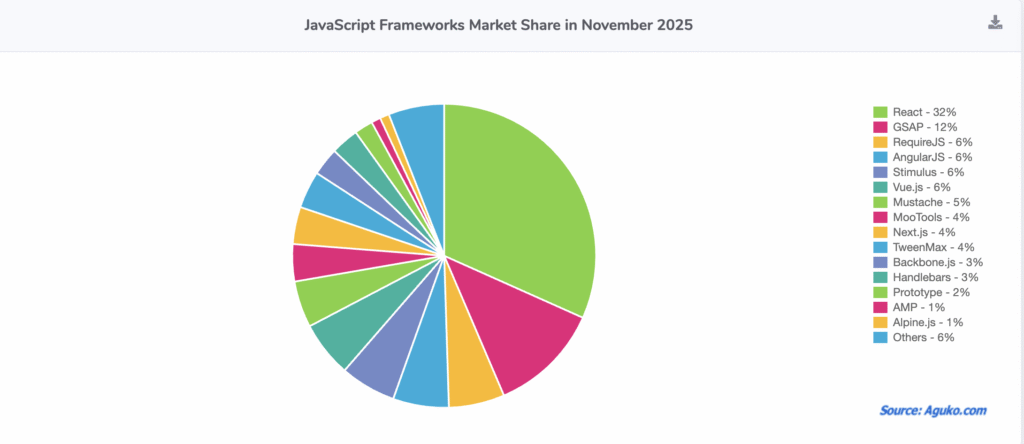
In 2025, choosing between React and Vue is more than a stylistic preference, it’s a strategic decision that can shape your product’s performance, development speed, and future scalability. React continues to dominate, with a 32 % market share among JavaScript frameworks as of November 2025. Meanwhile, Vue is steadily gaining ground, with some sources reporting nearly 22% adoption among developers in the latest JavaScript ecosystem surveys.
In this detailed guide, we’ll compare React vs Vue across multiple dimensions—performance, scalability, ease of use, ecosystem, job market, community strength, and ideal use case, so you can confidently choose the right framework for your next project.
1. React vs Vue in 2025
JavaScript frameworks continue evolving at lightning speed, but a key trend remains constant: businesses want fast, maintainable, and scalable apps. React and Vue have proven their reliability.
Here’s how they stand in 2025:
- React holds the highest adoption rate among enterprises and large-scale applications.
- Vue leads in developer satisfaction, simplicity, and ease of onboarding for beginners.
- Both frameworks now support advanced features like server-side rendering, type safety, and reactive architectures.
According to recent developer surveys:
- React is used by 42%+ of professional developers worldwide.
- Vue continues to grow steadily with a satisfaction rate above 70%.
- React dominates the job market, while Vue is more popular in fast-growing startups and Asian markets.
2025 is a year of evolution—not replacement. So instead of asking “Which is better?” the real question is:
Which one is better for your project?
Let’s dive deep.
Overview: What Are React and Vue?
React and Vue are two of the most popular JavaScript frameworks used to build modern, interactive user interfaces. Although they serve a similar purpose, their design philosophies, ecosystems, and development experiences differ significantly.
React, created by Meta in 2013, is a powerful UI library based on components and JSX—a syntax that allows developers to write HTML-like code directly inside JavaScript. It focuses on building fast, scalable, and dynamic applications using a Virtual DOM for efficient rendering. Because React is highly flexible, developers can choose their own routing, state management, and architectural patterns. This flexibility has made React the preferred choice for enterprise-level applications, SaaS platforms, and large development teams.
Vue, on the other hand, was introduced in 2014 by Evan You as a progressive framework that’s easy to learn and integrate. Vue uses a template-based syntax that feels familiar to anyone with basic HTML and JavaScript experience. It also includes official libraries for routing and state management, giving developers a complete ecosystem out of the box. Vue’s gentle learning curve and clean structure make it a favorite for startups, small-to-medium applications, and developers who value simplicity.
In essence, both React and Vue help developers build fast, interactive UIs—React prioritizes flexibility and scalability, while Vue focuses on ease of use and simplicity.
3. Key Differences Between React and Vue
React and Vue are both powerful tools for building modern web applications, but they differ in structure, philosophy, and approach. Understanding these differences can help you choose the right framework for your project.
| Feature | React | Vue |
|---|---|---|
| Type | UI Library | Full Framework |
| Language Style | JSX | HTML Templates |
| Learning Curve | Moderate/Steep | Beginner-Friendly |
| State Management | Redux, Zustand, MobX, Jotai | Vuex → Pinia |
| Enterprise Usage | Very High | Medium |
| Ecosystem | Massive, diverse | More structured |
| Performance | Excellent | Excellent |
| Scaling | Very scalable | Scales well but more suited for mid-large |
| Community Size | Largest in JS ecosystem | Smaller but highly active |
| SSR | Next.js | Nuxt.js |
4. Learning Curve: Which Is Easier in 2025?
When deciding between React and Vue, one key factor for developers and teams is the learning curve. In 2025, both frameworks have matured, but they still differ in complexity and ease of onboarding.
Vue Wins for Beginner-Friendliness
Vue is hands-down easier for beginners. Its file structure—template, script, style—is intuitive. You can start writing Vue in minutes.
Why Vue feels easier:
- Uses regular HTML templates
- Simpler reactivity system
- Clear, well-structured documentation
- Less boilerplate
Vue is often preferred by teams with junior developers or tight deadlines.
React Requires More Abstraction
React uses JSX, which blends JS with HTML. While powerful, it can overwhelm beginners.
React also requires understanding:
- useState, useEffect
- Hooks lifecycle
- Prop drilling
- External state management solutions
Verdict:
- For fast onboarding → Vue
- For long-term JS ecosystem fluency → React
5. Performance Comparison
Performance is a critical factor when choosing a frontend framework, especially in 2025, where users expect fast, responsive web applications. Both React and Vue offer excellent performance, but their approaches differ slightly.
React Performance
React uses a Virtual DOM to optimize rendering. When state changes occur, React efficiently calculates the minimal set of changes needed and updates only the affected components. Features like React Fiber and Concurrent Mode improve responsiveness for complex applications, while tools like memoization (React.memo, useCallback) help reduce unnecessary re-renders. React is particularly suited for large-scale applications with complex UIs and dynamic data.
Vue Performance
Vue also employs a Virtual DOM and leverages a reactive system that tracks component dependencies. With Vue 3, performance improved significantly thanks to the Composition API, better TypeScript integration, and faster diffing algorithms. Vue is optimized for both small-to-medium projects and applications with frequent state changes, making it highly efficient for interactive UIs.
Real-World Comparison
Benchmarks show that React and Vue have similar rendering speeds, with minor differences depending on app complexity. For most real-world applications, both frameworks deliver fast, smooth performance, and the choice should be guided more by project requirements than raw speed.
Verdict:
Vue offers slightly easier optimization and is ideal for smaller to mid-sized projects.
React excels in enterprise-grade, highly dynamic apps.
6. Ecosystem & Tooling
The ecosystem and tooling around a framework are crucial for developers in 2025. They determine how quickly you can build applications, integrate third-party libraries, and maintain your codebase over time. React and Vue both offer robust ecosystems, but they differ in size, flexibility, and approach.
| Feature / Tool | React | Vue |
|---|---|---|
| Server-Side Rendering (SSR) | Next.js | Nuxt.js |
| State Management | Redux, Zustand, Jotai, MobX | Pinia |
| Routing | React Router | Vue Router |
| Static Site Generation (SSG) | Gatsby | Nuxt.js |
| Build Tools | Webpack, Vite | Vite |
| Community & Support | Massive, global | Medium, growing |
| Flexibility | High, choose your own libraries | Opinionated, structured |
- React → Flexible, vast library ecosystem, great for large-scale apps.
- Vue → Streamlined, integrated tools, faster onboarding and development.
7. State Management
State management is a critical aspect of modern web applications, especially when building dynamic interfaces with React or Vue. It allows you to efficiently handle data flow, synchronize UI components, and ensure predictable behavior across your app.
React State Management
React provides basic state handling through useState and useReducer hooks, which are sufficient for simple applications. However, for larger and more complex apps, external libraries are commonly used:
- Redux: Industry-standard, highly scalable, supports middleware and complex state logic.
- Zustand: Lightweight and modern alternative for simpler state needs.
- Jotai & Recoil: Reactive state libraries designed for modular and flexible state handling.
React’s flexibility means developers can choose the right tool based on project complexity, but it also adds some learning overhead.
Vue State Management
Vue traditionally used Vuex, but in 2025, the official recommendation is Pinia, which is simpler and more TypeScript-friendly. Pinia offers:
- Modular store structure for better scalability
- Intuitive API with minimal boilerplate
- Integration with Vue Devtools for debugging
- Reactive state management built into Vue 3’s Composition API
Vue’s built-in solutions make state management easier to learn and implement, especially for smaller teams or projects that prioritize rapid development.
8. Developer Experience
Developer experience plays a crucial role in framework adoption, as it directly impacts productivity, maintainability, and overall satisfaction while building applications. In 2025, both React and Vue offer excellent developer experiences, but they differ in approach and learning comfort.
Here’s a quick, easy-to-read table for Developer Experience:
| Feature | React | Vue |
|---|---|---|
| Syntax | JSX (JS + HTML) | Template-based (HTML + JS) |
| Learning Curve | Moderate to steep | Easy and beginner-friendly |
| Component Structure | Flexible, modular | Single File Components (SFCs) |
| State Management | Multiple options (Redux, Zustand, etc.) | Built-in with Pinia |
| Developer Tools | React DevTools, Redux DevTools | Vue DevTools |
| Best For | Experienced developers, large-scale apps | Small teams, rapid development |
9. Use Cases: When to Use React vs Vue
Understanding the ideal use cases for React and Vue can help you make an informed decision for your 2025 project. Both frameworks excel in building modern web applications, but their strengths align with different project types and team needs.
When to Choose React
React is ideal for:
- Large enterprise applications
- Scalable platforms
- Complex dashboards
- Long-term corporate projects
- Cross-team collaboration at scale
- Apps requiring React Native
Examples:
- Airbnb
- Netflix
- Shopify
React is the enterprise standard.
When to Choose Vue
Vue is ideal for:
- Small to medium apps
- Prototyping
- MVPs
- Startups
- Projects requiring fast delivery
- Teams with mixed skill levels
- Apps with lots of UI interactions
10. Community & Job Market in 2025
The strength of a framework’s community and its job market are important factors when deciding which technology to adopt in 2025. A strong community ensures access to tutorials, libraries, plugins, and support, while a robust job market guarantees long-term career opportunities.
React Community
- Largest JS community
- Abundant resources, tutorials, and packages
- More job opportunities than Vue
- Dominant in US, Europe, and enterprise sectors
Vue Community
- Very active and helpful
- Popular in Asia, Europe, and creative tech stacks
- Growing job demand, especially in startups
React wins in job market size.
11. Server-Side Rendering: Next.js vs Nuxt.js
Server-side rendering (SSR) is an important consideration for modern web applications, as it can significantly improve performance, SEO, and user experience. Both React and Vue have strong SSR solutions: Next.js for React and Nuxt.js for Vue.
Next.js (React)
Industry standard for:
- SSR
- SSG
- Hybrid rendering
- API routes
- Edge functions
Backed by Vercel → extremely powerful.
Nuxt.js (Vue)
Nuxt 3 has improved dramatically:
- Faster
- Modular architecture
- SSR + SSG
- File-based routing
Nuxt is fantastic but not as widely adopted as Next.js.
12. React vs Vue: Scalability
Scalability is a critical factor for choosing a framework, especially when planning applications that are expected to grow in size, complexity, or user base. Both React and Vue support scalable architectures, but they differ in approach and suitability.
React Scalability
- Ideal for large, complex applications
- Better suited for multi-team development
- Flexible architecture allows enterprise structure
- Strong TypeScript ecosystem
Vue Scalability
- Great scalability for mid-size apps
- Supports modular architecture with Vue 3
- Nuxt improves structure for larger apps
React scales more naturally due to:
- More libraries
- Community patterns
- Corporate adoption
13. React vs Vue Comparison Table (2025)
| Category | React | Vue |
|---|---|---|
| Learning Curve | Moderate | Easy |
| Performance | Excellent | Excellent |
| Ecosystem | Huge, diverse | Structured, focused |
| State Management | Many options | Pinia (official) |
| Community Size | Largest | Medium-large |
| Enterprise Adoption | Very High | Moderate |
| Efficiency | High | Very High |
| SSR Framework | Next.js | Nuxt.js |
| Scalability | Enterprise-ready | Startup to Mid-size |
| Flexibility | Very flexible | More opinionated |
14. So Which One Should You Use in 2025?
Choosing between React and Vue in 2025 depends on your project requirements, team expertise, and long-term goals. Both frameworks are mature, performant, and capable of building modern, interactive web applications—but each shines in different scenarios.
Choose React If:
✔ You’re building a long-term enterprise project
✔ You need maximum flexibility
✔ You want a huge job market
✔ You’ll use React Native later
✔ You’re building a complex, scalable platform
Choose Vue If:
✔ You want fast development
✔ Your team includes beginners
✔ You value simplicity
✔ You’re building a startup/MVP
✔ You prefer clean HTML-based templates
React vs Vue
Choosing the right framework for your project in 2025 is crucial for long-term success. React is ideal for enterprise-grade applications, large teams, and projects requiring maximum flexibility, while Vue is perfect for startups, mid-sized apps, and rapid development with a simpler learning curve. Both frameworks are mature, performant, and capable of delivering modern, interactive web applications.
At Wavenest, we specialize in building scalable, API-driven applications using React and Vue, tailored to your business needs. Whether you’re launching a startup MVP or a complex enterprise platform, our expert team ensures efficient development and a seamless user experience.
Ready to start your project? Contact us today to get a free consultation and see how we can help you choose the right technology stack for your goals.
Both frameworks are powerful, modern, and production-ready. There is no universal “winner”. it depends on your project’s goals.