In 2025, the healthcare landscape is undergoing a profound shift as artificial intelligence (AI) and automation move from experimental tools to core pillars of clinical and operational care. According to a recent report, an estimated 89% of healthcare executives currently use AI in at least one clinical or operational function, and AI is projected to …


In 2025, the healthcare landscape is undergoing a profound shift as artificial intelligence (AI) and automation move from experimental tools to core pillars of clinical and operational care. According to a recent report, an estimated 89% of healthcare executives currently use AI in at least one clinical or operational function, and AI is projected to reduce U.S. administrative healthcare costs by $20 billion annually.
What is AI Automation in Healthcare?
AI automation in healthcare refers to the use of artificial intelligence technologies—such as machine learning (ML), natural language processing (NLP), large language models (LLMs), and robotics—to automate processes that traditionally required human intervention. Unlike rule-based automation, AI automation can learn from data, adapt to new patterns, and support complex decision-making.
Applications of AI automation include:
- Transcribing clinical notes automatically during patient consultations.
- Triage and symptom assessment using AI-powered algorithms.
- Automating billing, claims processing, and other administrative tasks.
- Enhancing patient engagement with AI-driven chatbots and reminders.
SEO keywords: AI automation in healthcare, healthcare automation tools, AI in healthcare 2025, automated clinical workflows, AI-driven diagnostics, patient engagement AI.
Why AI Automation is Crucial in 2025
The healthcare industry faces multiple challenges, and AI automation addresses several of them efficiently:

Efficiency and Cost Reduction
Administrative and operational tasks consume significant time for healthcare providers. AI automation can handle repetitive tasks like documentation, claims processing, and scheduling, freeing clinicians to focus on patient care.
Improved Patient Outcomes
AI tools can detect diseases earlier, assist in diagnostics, and offer personalized treatment recommendations. Automated systems reduce human error and improve the overall quality of care.
Data-Driven Insights
Healthcare generates massive amounts of data through EHRs, imaging, and wearable devices. AI automation transforms this data into actionable insights, enabling predictive analytics and proactive interventions.
Workforce Shortages and Access Gaps
With limited healthcare professionals and increasing patient demand, AI helps scale services efficiently. Virtual assistants, automated triage, and remote monitoring ensure better accessibility for patients.
Regulatory and Policy Support
Governments and regulatory authorities are increasingly supporting AI adoption in healthcare, establishing frameworks to ensure compliance, safety, and ethical usage.
Key Use-Cases of AI Automation in Healthcare
AI automation has already proven its value across several key healthcare functions:
Clinical Documentation and Scribing
Healthcare providers spend hours on documentation, leading to burnout. AI-powered scribe systems can:
- Automatically transcribe consultations.
- Summarize patient visits into structured notes.
- Reduce after-hours charting workload.
This allows physicians to spend more time with patients and less time on paperwork.
Administrative Tasks
Administrative processes such as scheduling, billing, and insurance claims are time-consuming and prone to errors. AI automation improves accuracy and efficiency while reducing costs.
Diagnostics and Imaging Analysis
AI tools can analyze medical imaging such as X-rays, CT scans, and MRIs with high precision, often identifying anomalies faster than humans. Predictive AI algorithms can also forecast patient deterioration or readmission risks based on historical data.
Workflow Automation in Hospitals
AI can optimize hospital workflows, including:
- Patient triage and bed allocation.
- Medication delivery and inventory management.
- Discharge planning and follow-ups.
Automated workflows improve operational efficiency and enhance patient satisfaction.
Patient Engagement and Virtual Care
AI-driven chatbots, virtual assistants, and remote monitoring systems enhance patient engagement by:
- Triaging symptoms and providing health advice.
- Sending reminders for medication, appointments, or tests.
- Offering 24/7 support to patients with chronic conditions.
Drug Discovery and Life Sciences
AI automation accelerates drug development by:
- Analyzing large datasets to identify potential compounds.
- Optimizing clinical trial design and recruitment.
- Predicting treatment outcomes and therapeutic efficacy.
This reduces costs, shortens timelines, and improves access to innovative therapies.
Top AI Automation Tools Transforming Healthcare in 2025
Healthcare organizations are leveraging a variety of AI automation tools. Here’s a closer look at the top categories:
Clinical Documentation and Ambient Scribing Tools
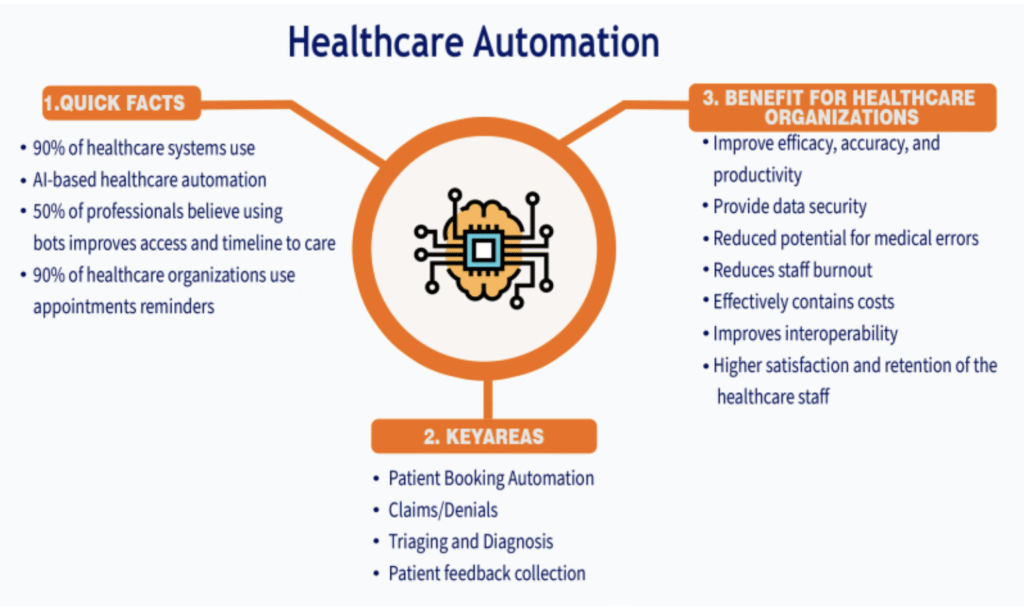
Tools in this category reduce physician workload by capturing clinical conversations and generating structured notes automatically. These solutions combine voice recognition, NLP, and EHR integration to streamline documentation.
Benefits include:
- Reduced administrative burden on physicians.
- Increased patient-facing time.
- Minimized documentation errors.
SEO keywords: AI medical scribe, ambient clinical documentation, healthcare documentation automation tool 2025.
Workflow Automation and Administrative Tools
AI-powered workflow automation tools help healthcare organizations manage repetitive tasks efficiently. Examples include:
- Claims and billing processing automation.
- Appointment scheduling bots.
- Staff and resource allocation systems.
Benefits include reduced operational costs, fewer errors, and faster task completion.
SEO keywords: healthcare workflow automation tools, administrative automation healthcare 2025, RPA in healthcare billing automation.
Predictive Analytics and Diagnostics Tools
Predictive AI tools provide data-driven insights to improve patient outcomes. These tools analyze medical history, imaging, and other clinical data to:
- Identify high-risk patients early.
- Predict readmission rates and complications.
- Support clinical decision-making with actionable recommendations.
SEO keywords: predictive analytics healthcare AI tool, diagnostic AI automation tool 2025, AI-driven diagnostics healthcare.
Patient Engagement and Virtual Assistant Tools
AI-powered virtual assistants improve patient communication and engagement. These tools can:
- Triage symptoms and answer common health questions.
- Schedule appointments automatically.
- Provide personalized reminders for treatment adherence.
SEO keywords: patient engagement AI tool healthcare, virtual health assistant automation tool, AI chatbot healthcare 2025.
Drug Discovery and Life Sciences Tools
AI automation in life sciences accelerates research and clinical trials. Key features include:
- Analysis of large datasets to identify promising compounds.
- Predicting potential side effects or interactions.
- Optimizing trial protocols for efficiency and accuracy.
SEO keywords: AI automation in drug discovery healthcare, life sciences AI tool 2025, pharma AI automation tool healthcare.
Implementation Challenges of AI Automation in Healthcare
Despite its benefits, deploying AI automation comes with challenges:

Data Privacy and Security
AI tools must comply with HIPAA, GDPR, and other privacy regulations when handling patient data. Strong security measures and governance frameworks are essential.
Integration with Legacy Systems
Many healthcare organizations use outdated EHR systems. AI solutions must integrate seamlessly without creating silos or disrupting workflows.
Clinical Trust and Adoption
Clinicians need to trust AI tools for decision support. Bias, errors, or lack of transparency can limit adoption.
Regulatory and Ethical Considerations
AI automation must adhere to ethical standards, ensuring accountability, transparency, and safe use of patient data.
Change Management and Workforce Readiness
Implementing AI often requires workflow redesign, training, and cultural change to ensure smooth adoption.
Best Practices for Implementing AI Automation
To maximize the benefits of AI automation:
- Start with high-impact, low-risk use cases such as billing or documentation.
- Ensure robust data governance and compliance with regulations.
- Choose tools that support interoperability with EHRs and other hospital systems.
- Measure outcomes with KPIs like time saved, error reduction, and clinician satisfaction.
- Maintain human oversight with a human-in-the-loop approach.
- Establish a roadmap for responsible AI, including bias mitigation and continuous monitoring.
How to Choose the Right AI Automation Tool
Selecting the right AI tool requires careful evaluation:
- Define the Problem: Identify the specific process to automate.
- Map Existing Workflows: Understand current processes to pinpoint inefficiencies.
- Evaluate Vendor Capabilities: Ensure the solution meets your technical and compliance requirements.
- Check Scalability and Flexibility: The tool should handle growth and adapt to changing needs.
- Pilot Before Full Deployment: Test the tool with a proof-of-concept to measure effectiveness.
- Consider Total Cost of Ownership: Factor in implementation, maintenance, training, and savings.
- Plan Change Management: Ensure staff are trained, workflows are adjusted, and adoption is supported.
- Set Governance and Metrics: Monitor the tool’s performance, outcomes, and risks continuously.
SEO keywords: how to select healthcare AI automation tool, healthcare automation tool checklist, AI automation tool evaluation healthcare.
Future Trends in Healthcare AI Automation
Looking ahead, AI automation in healthcare is expected to evolve rapidly:
- Generative AI and Agentic AI: Models will autonomously summarize patient data, draft treatment plans, and assist clinicians in complex decision-making.
- Robotics in Care Delivery: Robotic assistants will support tasks such as medication delivery, patient monitoring, and surgical assistance.
- Hyper-Personalized Care: AI automation will enable individualized treatment plans using data from wearables, genomics, and EHRs.
- Edge AI and Real-Time Automation: On-device AI will enable real-time monitoring and clinical decision support at the bedside.
- Stronger Regulatory Frameworks: Regulations and ethical standards will evolve to govern AI deployment and ensure safety.
- Increased Interoperability: Secure data-sharing infrastructures will allow AI tools to access data across hospitals and borders.
Transform Healthcare with AI Automation in 2025
AI automation is no longer a futuristic concept—it’s a practical solution that enhances patient care, streamlines operations, and boosts efficiency for healthcare providers. By automating administrative tasks, clinical documentation, diagnostics, and patient engagement, medical teams can focus on what matters most: delivering high-quality, timely care.
Healthcare organizations ready to implement AI automation should start by identifying high-impact workflows, selecting tools that integrate seamlessly, and scaling gradually to maximize ROI. The right AI automation tools don’t replace clinicians—they empower them to work smarter, reduce errors, and improve patient outcomes.
If you’re ready to transform your healthcare operations with AI, our team at Wavenest can help. Explore our services to see how we support healthcare providers in streamlining workflows, enhancing patient engagement, and implementing AI-driven solutions.
Have questions or need personalized guidance? Reach out through our Contact Us page and start building your AI automation roadmap today.