Artificial Intelligence (AI) is no longer just a futuristic concept. It’s reshaping the way organizations manage people, culture, and growth. According to a report by IBM, more than 65% of HR leaders are already using AI to streamline hiring and improve employee engagement. The benefits of AI in human resource management go far beyond automation—it’s …


Artificial Intelligence (AI) is no longer just a futuristic concept. It’s reshaping the way organizations manage people, culture, and growth. According to a report by IBM, more than 65% of HR leaders are already using AI to streamline hiring and improve employee engagement. The benefits of AI in human resource management go far beyond automation—it’s about smarter decisions, better employee experiences, and more efficient workflows.
In this blog, we’ll explore the top benefits of AI in HR management, real-world examples, and how HR leaders can adopt AI-driven strategies to stay competitive in 2025 and beyond.
👉 Learn more about AI-driven HR solutions at Wavenest’s HR Technology Services.
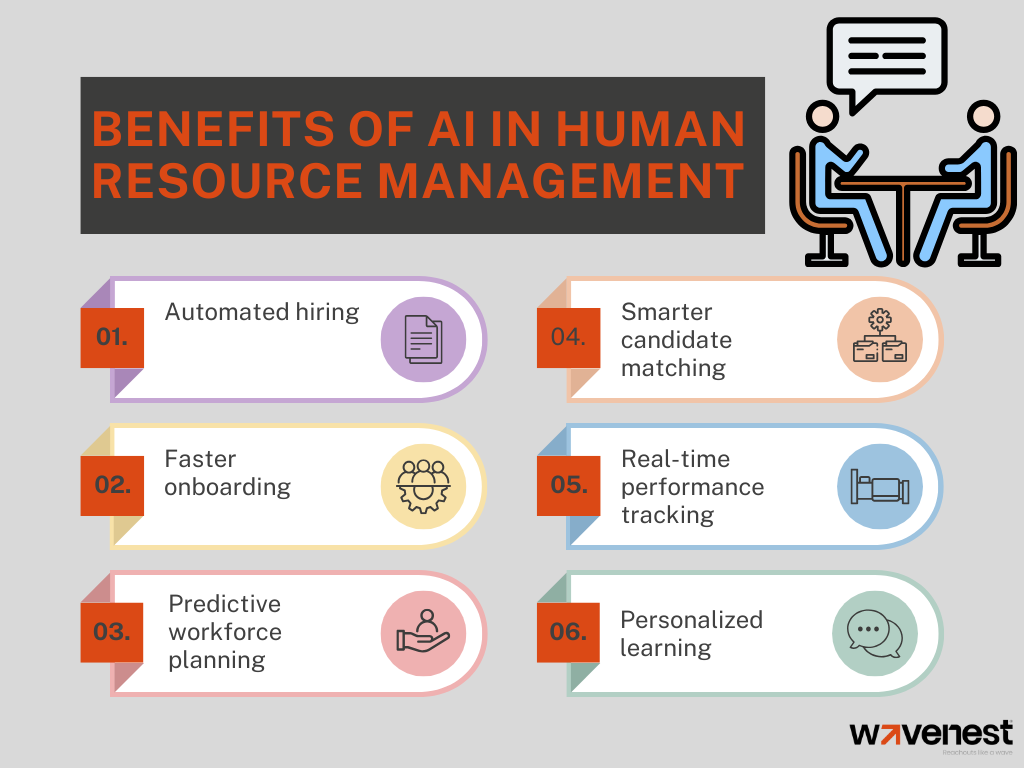
1. Smarter Recruitment with AI
Recruitment has always been one of the most time-consuming HR functions. With AI-powered hiring tools, companies can now identify top candidates faster and more accurately.
AI recruitment systems analyze thousands of resumes in minutes, filtering candidates based on skills, experience, and even cultural fit. Tools like HireVue and Pymetrics use natural language processing (NLP) and machine learning to predict a candidate’s suitability for a role.
Key Benefits:
- Reduced hiring time by up to 75%
- Improved candidate matching
- Elimination of unconscious bias in hiring
- Enhanced candidate experience through AI chatbots
Example Table:
| Feature | Traditional Hiring | AI-Powered Hiring |
|---|---|---|
| Resume Screening | Manual and slow | Automated and accurate |
| Candidate Communication | Email-based | AI chatbot assistance |
| Hiring Time | 4–6 weeks | 1–2 weeks |
| Decision Making | Human intuition | Data-driven insights |
By adopting AI-driven HR tools, organizations can focus more on people, not paperwork.
2. Enhancing Employee Engagement and Experience
AI plays a critical role in understanding and improving the employee experience. Through AI analytics, HR teams can track engagement patterns, feedback, and productivity in real-time.
For example, AI platforms like CultureAmp and Workday analyze sentiment data from surveys and chat communications to measure morale and identify burnout risks before they affect performance.
AI also powers personalized learning and development programs. By analyzing employee data, AI suggests training modules, career paths, and mentorship opportunities tailored to each individual.
Key Benefits:
- Predicts and prevents disengagement
- Delivers personalized employee journeys
- Encourages continuous learning and growth
AI doesn’t just make HR efficient—it makes employees feel heard and valued.
3. Streamlining HR Operations through Automation
AI simplifies repetitive HR tasks, freeing professionals to focus on strategic initiatives. From payroll management and attendance tracking to leave approvals and compliance, automation ensures accuracy and consistency.
For instance, AI chatbots can handle employee queries about leave policies or benefits 24/7, reducing the workload on HR teams. Automated systems also minimize human errors in salary calculations or data entry.
Key Benefits:
- Reduced administrative workload
- Error-free HR documentation
- 24/7 employee assistance
- Better time management for HR teams
Example Table:
| Automated Process | Impact |
|---|---|
| Payroll Management | Ensures accuracy and saves time |
| Leave Requests | Faster approvals and tracking |
| Onboarding | Seamless digital experience |
| Employee Support | Always-available AI chatbots |
At Wavenest, our AI-driven automation tools help HR departments reduce manual work and improve employee satisfaction.
4. Data-Driven HR Decision Making
AI transforms HR from a support department into a data powerhouse. With predictive analytics, HR teams can forecast turnover rates, identify skill gaps, and make informed decisions about promotions or training investments.
For example, by analyzing past performance data, AI tools can predict which employees are likely to leave within the next six months. This enables HR to take proactive steps—offering career growth opportunities, mentoring, or rewards—to retain top talent.
Key Benefits:
- Improves workforce planning
- Reduces turnover and absenteeism
- Enhances fairness and transparency in decisions
- Identifies training needs proactively
Data-driven HR decision making helps businesses stay competitive while ensuring employees receive meaningful growth opportunities.
5. Improving Diversity, Equity, and Inclusion (DEI)
Bias in hiring and promotions has long been a challenge in HR. AI helps minimize bias by evaluating candidates based on objective data rather than subjective opinions.
For instance, AI can mask names, gender, or ethnicity during resume screening, focusing purely on qualifications and experience. Moreover, AI-driven analytics can reveal hidden patterns of bias within company data, allowing HR teams to address inequality at its root.
Key Benefits:
- Promotes fair hiring practices
- Encourages equal opportunities for all employees
- Reduces unconscious bias
- Supports compliance with DEI policies
Companies that embrace AI-powered DEI tools are building more inclusive and innovative workplaces.
6. Personalized Learning and Development
AI is revolutionizing how employees learn and grow within organizations. Instead of offering the same training to everyone, AI customizes learning based on individual skills, goals, and performance data.

For example, an employee struggling with communication might get AI-recommended courses or simulations to improve soft skills, while a data analyst may receive suggestions for advanced analytics training.
Key Benefits:
- Personalized learning paths for each employee
- Increased retention through career development
- Data-backed recommendations for upskilling
- Measurable training ROI
AI helps HR teams align employee growth with company goals—creating a win-win environment for both sides.
7. Predictive Workforce Planning
AI allows HR leaders to anticipate workforce needs and plan for future changes. By analyzing trends in hiring, performance, and market data, AI tools can predict talent shortages or surpluses months in advance.
For instance, predictive models can help companies determine when they’ll need new roles, what skills will be critical, and how to allocate resources effectively.
Key Benefits:
- Better forecasting of workforce needs
- Efficient budgeting for hiring and training
- Reduced risk of talent shortages
- Strategic decision-making for HR leaders
With AI-powered workforce planning, companies can adapt faster to change and maintain a competitive edge in talent management.
Why These Benefits Matter
The benefits of AI in human resource management extend beyond efficiency—they redefine the HR function as a strategic partner in business growth.
| Impact Area | Transformation Through AI |
|---|---|
| Hiring | Faster, unbiased, data-driven |
| Engagement | Personalized and predictive |
| Retention | Proactive and insight-based |
| Productivity | Increased through automation |
By using AI, HR teams are not only cutting costs—they’re creating smarter, more human workplaces where people can thrive.
How HR Leaders Can Prepare
To fully leverage the benefits of AI in HR management, HR leaders should:
- Start small but strategic: Begin with one AI use case like recruiting or engagement tracking.
- Invest in AI literacy: Train HR professionals to understand and interpret AI-driven insights.
- Choose the right tools: Select platforms that align with company goals and integrate with existing HR systems.
- Ensure ethical AI use: Maintain transparency and fairness in AI-based decisions.
HR leaders who adapt early will position their organizations as forward-thinking, employee-centric, and efficient.
FAQs
1. What are the main benefits of AI in human resource management?
The main benefits include faster hiring, improved employee engagement, data-driven decision-making, and enhanced DEI efforts. Learn more about HR automation tools at Wavenest.
2. How can AI improve recruitment in 2025?
AI recruitment systems analyze resumes, assess candidates, and predict job performance. This results in faster, bias-free, and smarter hiring decisions.
3. Is AI replacing HR professionals?
No. AI enhances HR professionals’ work—it automates repetitive tasks so they can focus on people, strategy, and culture.
4. What are the top AI tools for HR managers in 2025?
Tools like Workday, SAP SuccessFactors, and Wavenest’s HR automation solutions help manage data, automate workflows, and improve employee experiences.
5. How can I start using AI in my HR department?
Start with simple automation tools, analyze results, and expand gradually. For tailored solutions, visit Wavenest HR Services or Contact Us.
Final Thoughts
AI is redefining the HR landscape by making it more intelligent, inclusive, and efficient. From hiring to engagement, analytics to learning, the benefits of AI in human resource management are transforming how businesses operate.
At Wavenest, we help organizations integrate AI-driven HR solutions that empower teams, optimize workflows, and boost performance.
Ready to make your HR smarter? Contact Us today to start your digital HR transformation journey.